|
Welcome!
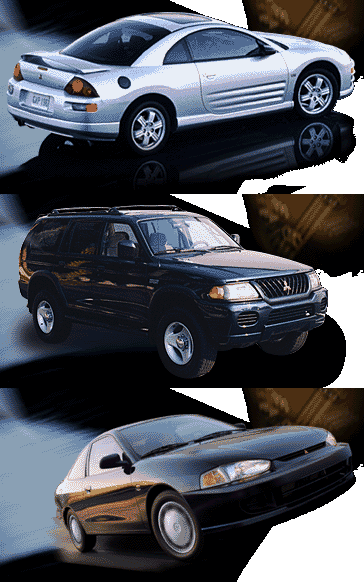
This site showcases Mitsubishi and includes everything from pictures, to news, to racing info, to instructions for new Mitsubishi's
The Establishment of
Mitsubishi Motors Corporation
Mitsubishi's motor vehicle business had become so important and successful an enterprise by the end of the 1960s that the creation of a single operation to focus on that business was an obvious way forward. In 1970, the Motor Vehicle Division of Mitsubishi Heavy Industries Ltd. became independent under the name Mitsubishi Motors Corporation (MMC). So it was with a renewed optimism and sense of purpose that the fledgling company, but with a rich inheritance of technology behind it, entered the 1970s.
One area of concentration for MMC was the further development of its own infrastructure in Japan, covering all fields from R&D and production to distributor networks and after sales service. Yet it was an event in Australia that pointed MMC in the direction of a global role. In 1972, a Galant 16GLS won outright the 7th Southern Cross Rally, a highly prestigious long-distance rally raid covered by the world's motoring press. The next year, the same event was won by a Lancer 1600GSR, the Lancer series having been launched only months earlier. The same model repeated its Australian success in 1974, when it also won the East Africa Safari Rally, and again in 1976. MMC was now demonstrating the superb performance and reliability qualities of its vehicles on a world stage.
While Mitsubishi cars were winning such honors, MMC was busy setting up an international distributor network to get their vehicles into the hands of a sophisticated motoring public that understood the virtues that Mitsubishi vehicles embodied. Following the 1973 "Oil Crisis," the world felt the power of the oil producing nations. Even as the price of gasoline spiraled, motorists were reluctant to sacrifice performance for fuel economy.
In combining economy with performance, Mitsubishi cars set a standard that captured the imagination. The decade ended with the Colt 1400 GLX winning Japan's Motor Fan magazine's "Car of the Year" award and the L200 taking the "USA's Pickup of the Year" award given by Pickup, Van & 4WD magazine.
Mitsubishi Motors had also been breaking new ground on the technology front, most significantly in the development of Silent Shaft technology for the Astron 80 engine. This was a world-first achievement and was saluted by Japan's Automobile Technology Association with its "Prize for Science." Japanese automobile technology in general was now respected worldwide, and Mitsubishi was once again at the forefront of innovation.
Global Expansion
Mitsubishi was determined to become one of the world's leading auto manufacturers. There was no question about the excellence of its products, so Mitsubishi Motors Corporation (MMC) was confident in its decision to go seriously global. The success of the 1980s provided full justification for that confidence.
One important aspect of Mitsubishi's global expansion was sponsorship of big, international events. MMC took the first of many steps along this road when it became official vehicle supplier to the 1984 Olympics in Sarajevo and the 1987 Universiade Games in Zagreb, both venues in the former Yugoslavia. Mitsubishi cars were seen by TV audiences all over the world.
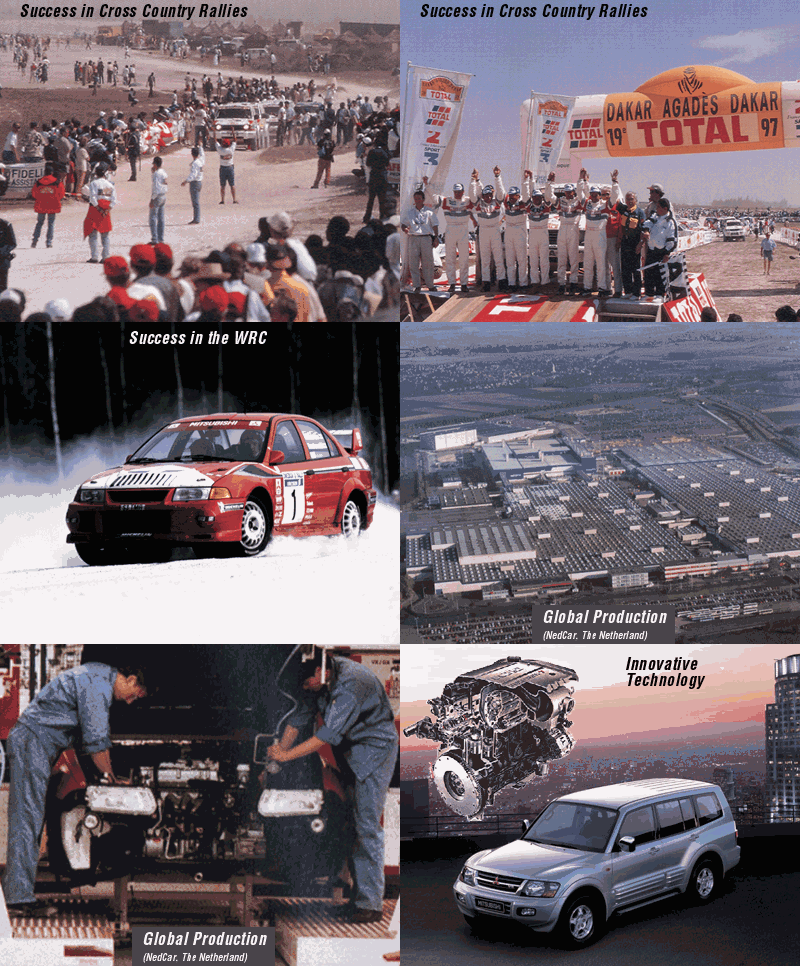
One of the models supplied for both events was the Mitsubishi Pajero (Montero), which in many ways personifies the progress MMC has made as a world's top manufacturer. The Pajero, first launched in 1982, was quite different from anything seen before in the 4WD category. Here was an off-roader with real performance, real comfort and great looks! Incredibly, in the 1983 Paris-Dakar Paris Rally, the world's greatest adventure rally, Pajeros won the Unmodified 4WD Production Class, the Marathon Class and Best Team Award. In 1985, a Pajero won the Dakar outright. A legend had been born. Not surprisingly, the Pajero became a global best-seller. So many were the honors awarded to the Pajero in so many countries that mention of one of the most prestigious must suffice here. In 1986, the UK's What Car? named the Pajero its "4x4 of the Year."
The Pajero was not alone in the honors list. In 1984, the Mitsubishi Galant won Germany's "Das Goldene Lenkrad" (Golden Steering Wheel) award, a feat repeated by the Colt and the Lancer in 1988. Domestically, the Galant VR-4 was voted the "Japanese Car of the Year 1987-1988." Again, lack of space rather than modesty forbids highlighting of the many other awards won by Mitsubishi vehicles in the 1980s. The Mitsubishi reputation for performance, reliability and technological brilliance was now truly confirmed in the eyes of the world.
By the end of the decade, MMC had also extended its assembly and production facilities on an international scale. In this area, the most significant step was the opening in 1988 of a state-of-the-art production plant in Bloomington, Illinois by Diamond Star Motors Corporation, a joint venture between Mitsubishi and Chrysler
Toward the 21st Century
The decade of the 1990s saw the Pajero (Montero) continue its winning ways in rally raids. In the 1992 Paris-Cape Town event, Pajeros took 1st, 2nd and 3rd places. The following year, a Pajero won the Paris-Dakar Rally. In 1997 and again in 1998 Pajeros swept the first three places in the event. These victories were complemented by a host of class wins.
Just as significantly, Mitsubishi cars began to make their mark in the World Rally Championship, a series that gives auto makers the opportunity to showcase the on road (everything from smooth tarmac to rough mountain tracks and forest grit) capabilities of their vehicles. The ascent to greatness started in 1991, with Galant VR-4s winning the Swedish Rally and the Cote d'Ivoire Rally. From 1996 through 1999, Mitsubishi works driver Tommi Makinen, driving a Lancer won the ultimate crown, the WRC Driver's Championship, an unprecedented four times straight.
In the same years, Argentina's Gustavo Trelles, also in a Lancer, won the WRC Group N Championship. For Mitsubishi, this achievement was as thrilling as Makinen's, for Group N cars are basically showroom-standard vehicles, the kind ordinary motorists can buy. This triumph came on top of innumerable wins for Group N Lancers in many national rally series.
As the Mitsubishi image soared to new heights, MMC pressed ahead with expanding its overseas production network with a view to becoming a true citizen of the world. In 1995, the first Mitsubishi car produced in Europe, the Carisma, rolled off the line at NedCar in Holland, a joint venture between MMC, Volvo and the Dutch government. 1996 saw the start of Sigma and Sigma Station Wagon production in Australia, and the L200 in Thailand.
Technologically, Mitsubishi's emphasis in the years leading up to the 21st century was firmly on safety and protection of the environment. In 1990, MMC introduced the world's first Traction Control System, fitted to models in the Sigma series. Super Select 4WD and Multi-mode ABS followed in 1991 and INVECS in 1992. In 1994, MMC began commercial production of its Libero EV electric car. 1996 saw the development of the unique, revolutionary GDI engine, which provides massive reductions in fuel consumption without compromising power output. By the end of 1997, the GDI engine was fitted to the Galant, Pajero, Diamante, Challenger (Montero Sport), Chariot (Space Wagon), RVR (Space Runner) for the domestic market and the Carisma for the European market. IN 1997, Mitsubishi marked its first 80 years of life as a vehicle manufacturer as it had started, way out in front.
mitsubishi gallery
|
 New Alliances for Growth
On October 18, 2000, an event took place that will shape the future of Mitsubishi Motors Corporation (MMC) for years to come.
On that date, MMC and DaimlerChrysler formally signed the terms of a strategic alliance designed to ensure the prosperity of both partners in an age when size is all-important in an international auto industry remarkable for the intensity of the competition within it. The combined unit sales and revenues of the allies puts them among the top three of the world's automotive giants.
What are the perceived advantages of the alliance? While both MMC and DaimlerChrysler will continue as independent entities, the alliance increases the power of both parties. In respect of market access, MMC becomes stronger outside Asia, including North America and Europe, and DaimlerChrysler becomes stronger within Asia, including Japan. The combined product mix gives a better balance, to be further strengthened by cooperation in design, development, production and distribution, for growth in all markets. Both parties will benefit from economies of scale. Small cars produced by NedCar for the European market under the Mitsubishi and Mercedes brand-names will share a common platform and GDI engine technology. In addition, both parties will press ahead with cooperative development of new products, engines and environmental technologies. The agreement covers passenger cars and light commercial vehicles, but excludes medium and heavy-duty trucks, and other commercial vehicles. DaimlerChrysler will give Mitsubishi Motors access to its worldwide financial services network.
.
|


