World Rally Championchip 2000
Archiv:2000;The Marlboro Mitsubishi Ralliart crew of Tommi Makinen and Risto Mannisenmaki finished the 2000 FIA World Rally Championship season off on a high note with a fine third position in the Rally of Great Britain.
And, the Mitsubishi Motors crew of Manfred Stohl and Peter Muller have won the FIA World Cup for Drivers of Production Cars after a fine drive and a category victory today.
The year 2000 marks the end of MakinenÒ€ℒs four-year reign as World Champion, but national honours remain intact and the Finn hands the coveted trophy to fellow countryman Marcus Gronholm. The Peugeot star, who finished second in Great Britain in only his first full season in the series, is FinlandÒ€ℒs sixth World Rally Champion and, after victories in Sweden, New Zealand, Finland and Australia, richly deserves the title. SubaruÒ€ℒs Richard Burns did all that was in his power to stop the Finn, the Briton recovering well from a disastrous opening day to clinch a unique hat-trick of home wins, but it was simply not enough to fulfil every sportsmanÒ€ℒs dream. He finishes runner-up in the series for the second consecutive year, followed by Carlos Sainz, Colin McRae and MitsubishiÒ€ℒs Tommi Makinen.
Peugeot has taken a clean sweep of the titles this season, the French make also winning the ManufacturersÒ€ℒ Championship for the first time since 1986. Ford, Subaru and Mitsubishi took second, third and fourth respectively.
Driving rain and gale force winds hit Wales last night, threatening a treacherous concluding leg on the Rally of Great Britain. However, as the crews left the start ramp in Cardiff early this morning, the rain had essentially passed, the skies turned blue and only a gusting wind remained. Three forest stages and 84 competitive kilometres lay in wait and, with the fight for the remaining top positions split by only handfuls of seconds, there was no respite for the worldÒ€ℒs finest rally drivers.
The Marlboro Mitsubishi Ralliart crew of Tommi Makinen and Risto Mannisenmaki dropped time to FordÒ€ℒs Carlos Sainz in the opening stage, but fastest time by the Finns in the proceeding stage elevated them back up into third position with just over a second separating the rivals. "The first stage we went a bit too carefully and couldnÒ€ℒt find the best speed. We were trying to be fast and safe at the same time", commented Tommi. "The second stage was much better and we just went flat-out".
In the final stage of the rally, and indeed the 2000 Championship, Makinen set fastest time to maintain his position and register a firm 18.5 second lead over fourth placed Carlos Sainz. "It is an important and good result for us, our best finish on this rally. We had some problems, most of which I was making myself, but itÒ€ℒs a good end to the season and we are very well prepared to take my title back next year. The team has done a great job all season and we must also pay thanks to Phil (Short) for his big contribution to the success of the team".
In Group N, the Mitsubishi Carisma GT crew of Stohl and Muller have led the series all year and, with victories in Monte Carlo, New Zealand, Corsica and now Great Britain, the pairing have finally brought an end to Gustavo TrellesÒ€ℒ four-year stranglehold on the series. Their efforts, along with a host of other star drivers, has also netted a quite unprecedented string of victories for Mitsubishi, the Japanese manufacturer claiming 14 Group N wins from 14 outings this season."IÒ€ℒm obviously very happy", said a beaming Manfred. "I was quite relaxed today in fact. The stages have been quite slippery but we have not been under any real pressure. I didnÒ€ℒt expect the Championship to go to the last round, but with rallies you just never know what to expect".
Twenty-eight-year-old Stohl came to Great Britain just one point ahead of Trelles after a year-long battle over snow, ice, asphalt and gravel and, with everything to fight for, the rivals knew that whoever finished ahead here in Wales would take the coveted World title.
ustavo Trelles effectively lost the fight yesterday when punctures hampered his charge, the burly Uruguayan having to run on flat rubber due to the fact that Group N cars are not allowed to carry two spare wheels, nor be assisted by anti-deflation mousse. By contrast, AustriaÒ€ℒs Stohl has had a completely trouble-free run in his reliable Carisma GT and a measured drive has reaped rich rewards. "This rally is not a lucky one for us", commented Gustavo, "but IÒ€ℒve never finished it before so at least this year we managed to do that".
Mitsubishi has again taken a clean sweep of the Group N leaderboard, its drivers claiming no fewer than nine of the leading positions. SwedenÒ€ℒs Kenneth Backlund, in his first outing in Great Britain, finished a fine second in his Carisma GT. "I like these stages better in leg three. Today IÒ€ℒve just been aiming to finish, but itÒ€ℒs nice to get a good result here the first time", he said.
FinlandÒ€ℒs Olli Harkki finished third in the category, with Peruvian Ramon Ferreyros fourth in his Lancer Evolution. Britons Gavin Cox and Jeremy Easson rounded off a truly international top six. "Our aim was to get back in front of Jeremy and weÒ€ℒve been trying quite hard", said Cox. "I think itÒ€ℒs been more slippery today and it hasnÒ€ℒt been easy".
The FIA World Rally Championship may well be over for another season, but Marlboro Mitsubishi Ralliart and itÒ€ℒs 2001 drivers Tommi Makinen and Freddy Loix are already looking ahead to next year. Ice, asphalt and snow testing for the opening rounds in Monte Carlo and Sweden starts in less than a week, and the team is gearing up for an all-out assault on next yearÒ€ℒs Championship, which starts in less than seven weeks.
|
|
|
|
Mitsubishis Celebrate On Podium after Fastest Dakar Rally Ever
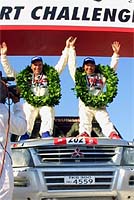
Team Mitsubishi France crew Jean-Pierre Fontenay and Gilles Picard of France celebrated a superb third place at the finish of the Dakar 2000 Rally today in Cairo, Egypt, after pushing their Mitsubishi Pajero/Montero to its limits on one of the fastest Dakar rallies ever known. In first place was Frenchman Jean-Louis SchlesserÒ€ℒs lightweight buggy, which took advantage of the fast conditions, with fellow countryman Stephane Peterhansel second in his Mitsubishi-powered Mega Desert special.
It was a tough event, packed with drama and incidents, but the long, high speed special stages of the second half of the event in Libya turned the rally into a drag race, which handed victory on a plate to the lightweight buggy with its high top speed.
The Dakar 2000 promised to be one of the most challenging yet seen, with a completely new route running from Dakar in Senegal, almost straight across the centre of North Africa, to Cairo in Egypt. 7,616 km of special stages were planned in an overall route of 10,905 km, with some stages almost 800 km long. After the start in Paris, France, the cars were shipped to Dakar for the rally proper to begin, and initially, it was the Mitsubishis that stamped their authority on the event. The stages werenÒ€ℒt perfectly ideal for the most part, fast clay tracks baked hard by the sun, but there were enough technical driving challenges that required handling, traction and skill to allow the Mitsubishis to grab the advantage, although speeds were still high.
Carlos Sousa of Portugal slipped into the lead on the first stage in Senegal in his Team Mitsubishi Portugal Strakar/L200, but the more experienced Team Nisseki Mitsubishi Ralliart Pajero/Montero driver Kenjiro Shinozuka, navigated by Dominique Serieys, both former Dakar winners, moved in front on the second leg to head a Mitsubishi 1-2-3 with Sousa second and Japanese/German pairing Hiroshi Masuoka and Andreas Schulz third, also in a Pajero/Montero.
But the margins were tight, with only seconds separating the top crews. Shinozuka crept further into the lead as the rally moved from Senegal to Mali, but SchlesserÒ€ℒs ultra-fast buggy and PeterhanselÒ€ℒs lightweight Mega Desert were always close by, challenging hard. By leg four in Burkina Faso, on hot, dusty tracks Shinozuka was still in front, while all-girl crew Jutta Kleinschmidt of Germany and Tina Thorner of Sweden took their first stage victory in their Team Mitsubishi Germany Pajero/Montero. After early problems with punctures, this marked a comeback fight from Jutta and Tina, who still hoped to gain a place a day until Cairo to win!
By leg 5, Miguel Prieto was also making a dramatic comeback in his Team Mitsubishi Spain Pajero/Montero. After sever early delays he was 109th on leg two, but by leg five he had climbed back to 32nd. French pair Jean-Pierre Fontenay and Gilles Picard were having a more difficult time in their Team Mitsubishi France Pajero/Montero with niggling problems such as brake malfunction and then getting lost briefly in Burkina Faso when Jean-Pierre took a wrong turn, distracted by giving a live commentary to a TV crew hovering overhead in a helicopter!
The rally then moved into Niger on leg 6, heading for Niamey. Shinozuka crept further ahead, leading by 6m 15s from Schlesser as the rally moved away from the dusty clay tracks and tropical forests and into the sandy sub-Saharan Sahel. The first sand dunes appeared on the route alongside the banks of the River Niger and the event began to take on a different look.
Fontenay was fourth, despite a close shave with a two-metre hole that nearly swallowed his Pajero/Montero. He noticed it at the last minute and managed to stop just in time, commenting that his brakes were obviously now working well! Fellow Mitsubishi driver Masuoka was less fortunate however, plunging straight into the hole, blinded by dust clouds from the cars in front. He soon got towed out, and the super-strong Mitsubishi was virtually undamaged! Kleinschmidt had managed to work her way back up to sixth by this point, but made no progress on the leg to Niamey after hitting a tree stump and picking up yet another puncture. Prieto was now up to an impressive 25th.
Then the first of two rally disasters struck. The French authorities warned the rally organisers that they should not progress further into Niger, as there were threats of heavy terrorist activity that could endanger the rally. The organisers were obliged in the interests of safety to cancel the next five days of rallying - the first time this had happened in 22 years - and airlift the entire entourage to Libya. It was a massive undertaking. Three huge Russian Antonov 124 cargo planes, each with a 73 metre wingspan and capable of carrying over 100 tonnes, were drafted into action. Eighteen 10 hour flights over five days were planned to airlift 336 vehicles and 1,365 people to Sabha in Libya, were the restart was planned to take place on January 17. Amazingly, everything went to plan. The Antonovs worked day and night without incident, and on January 17, the rally was again underway, this time in Libya and the start of the real desert stages.
Initially, it was business as usual with Shinozuka creeping ahead yet again to increase his lead to 7m 10s over the short 146 km special stage to Waw El Kebir with its amazing 40 metre high sand dunes. But on the 12th stage, the rally suddenly took a turn for the worse for anyone driving a proper car. Recent rains, followed by cold, dry weather had turned the sand to concrete. The Dakar 2000 turned from a rally into a drag race as the cars blasted their way across the desert floor for two or three hundred kilometres at a time at top speed. For the cars, it was a disaster as the lightweight buggies, over 600 kg lighter than the Mitsubishis, raced into the lead with their higher top speeds. There was nothing to challenge either car or driver - it was like driving on a motorway. Leg 12 was 657 km long, and Shinozuka, became the leading car in third place, with Schlesser and Peterhansel first and second respectively in their "specials".
Then disaster struck again. The high-speed stages and the need to chase the buggies meant car drivers were taking chances, and soon a price had to be paid. Four cars, three of them Mitsubishis and one a Nissan, blasted over the top of a sand dune 63 km into stage 13 and spiralled into high-speed rolls on the other side of a steep drop. Shinozuka, Sousa, Prieto, all three in Mitsubishis, and Greogoire de Mevius in a Nissan, all crashed heavily into retirement. Medical rescue helicopters rushed the four drivers and their four navigators to the Medical centre and then to the University Hospital in Tunisia for checkups, and the rally continued without them.
Jean-Pierre Fontenay then took up the Mitsubishi banner to moved up to third, but there was nothing he could do in the conditions to catch the Schlesser buggy which opened up a lead of a quarter of an hour over Peterhansel and half an hour over Fontenay.
The next long 789 km stage which brought the rally into Egypt and the Oasis of Dakhla sealed the result, and FontenayÒ€ℒs third place, with Kleinschmidt fifth and Masuoka sixth was the best the Mitsubishi, or any car driver, could expect. Once in Egypt, the nature of the rally changed again, but with only two proper stages remaining, both relatively short, it was too late for the cars to catch up. The 352-km stage around Dakhla was much more technical, although still fast in places, in the Western Desert, and over dunes, through white marble valleys and a spectacular descent over a cliff of cascading sand, the Mitsubishis scored a 1-2-3 stage victory headed by Fontenay. On the penultimate stage, it was Hiroshi MasuokaÒ€ℒs turn and he blasted his way to a spectacular stage victory in his Pajero/Montero.
In the end, however, the high-speed nature of the stages made it impossible to win in anything other than a light-weight special, and with Schlesser celebrating victory and Peterhansel second, Fontenay could take comfort in being the best of the "proper" cars in his Mitsubishi Pajero/Montero in third.
He said at the finish at the Pyramids in Cairo: "The Dakar 2000 was very fast. IÒ€ℒm sorry that there were no more challenging stages, which the Dakar should have had. I really wanted to win this year, but I will enter again next year to win!"
Hiroshi Masuoka added: "It was a shame that we couldnÒ€ℒt do the whole rally. I wanted to drive the stages in Niger. But after the rally entered Egypt I had great fun and I think I was able to demonstrate the real abilities of the Pajero/Montero in proper rally conditions. IÒ€ℒm not satisfied with sixth place, but very happy with our performance in Egypt.
Kleinschmidt, who had been plagued by punctures throughout the event, stated: "This year the rally was very, very fast. IÒ€ℒm sorry I had so many punctures, which was very frustrating, but I would have preferred the Dakar to have been a real off-road rally which would have really shown the potential of the Pajero/Montero".
In the challenging T1 category, which is for virtually standard cars, Brazilian Klever Kolberg survived the adverse conditions to take an impressive second in class in his Mitsubishi Pajero/Montero.
High-speed or not, the Dakar 2000 was an extraordinary challenge, and for the 95 cars that eventually reached Cairo, the real sense of relief and achievement was overwhelming. In the end they had covered 7,869km, 5,018 km competitively, and it takes a special kind of driver, navigator and car just to get to the finish!
|
|
Cross-Country Rally
The 2000 Marlboro UAE Desert Challenge that took place in the vast and inhospitable sandy deserts and dunes around Abu Dhabi in the United Arab Emirates again saw a pitched battle between the prototype buggies and the improved production vehicle based Mitsubishi Pajeros for places in the event and the overall championship. The five day event (November 7th to 11th, 2000), which is the 9th Round of 2000 FIA World Cup for Cross Country Rallies, covered a 1700km course on its way to the finish in Dubai, and was seen by many as a good opportunity to test the people and machinery that will take part in the 2001 Paris-Dakar Rally that is to be held from January 1st to 21st, 2001.
he end of the first leg saw the top three Pajeros/Monteros mounted competitors Fontenay, Kleinschmidt and Shinozuka in 4th, 5th and 7th place respectively in conditions that favored the lighter and more powerful prototype buggies. Needless to say, the T2 class was totally dominated by the Pajeros/Monteros and they were all waiting for the sections of the course that would be more advantageous to them in the following legs of the event.
Shinozuka made up three place on the following leg to end the day in 4th place, but Kleinschmidt had the bad luck to crash her Pajero end-over-end, badly damaging the roof and completely smashing the front windscreen. Fontenay stopped to assist his team mate and they managed to get to the end of the day's leg in 5th and 7th place.
The weather on the third day, November 10th, took a turn for the worse, but this just played into the hands of the Mitsubishi Pajeros/Monteros and this was reflected in the results. Fontenay covered the course in the fastest time, over three minutes faster than the prototype buggy of last year's champion Jean-Louis Schlesser who described the conditions on the day's leg as 'Hellish.' Leader for the first few days, two-wheel and four-wheel cross country veteran Peterhansel, retired with engine trouble and the leader board that evening saw Shinozuka in 3rd, with Fontenay 4th and Kleinschmidt 6th.
The last day was again on a course that favored the buggies and there were no changes in the major placings. The fact that this event had been the final round of the World Cup meant that J-L Schlesser repeated as World Champion, and Jutta Kleinschmidt became runner-up, with Fontenay fourth and Shinozuka 6th in the points rankings for the year.
Commented Shinozuka at the end of the rally, 'I'm very happy to have finished in third place because the course suited the buggies better. Now my team mates and I are looking forward to the Dakar with a very positive attitude.'
47th Macau Grand Prix Nov.17-19
MITSUBISHI played a starring role alongside martial-arts movie superstar Jackie Chan and a lineup of Asia's leading actresses at the recent Macau Grand Prix.
The 15 Mitsubishi Lancers (called as Mitsubishi Lancer-Cedia in the Japan market and refers to the new model Lancer) and an open-topped Pajero iO were key players in the Golden Harvest/Mitsubishi Jackie Chan Cup - the annual celebrity race at the GP meeting.
Starlets from Singapore, Malaysia, Thailand, mainland China, Taiwan, Hong Kong and Korea drove the Lancers - each with a professional racing driver alongside to guide them.
Jackie Chan led the field on two parade laps of the Macau street circuit in the open-topped, 1800cc Pajero before acting as official starter for the race.
It's the first time that the annual Jackie Chan race has enlisted actresses Asia-wide to drive.
Thai starlet Anongnad Tanwimon - guided by top Asian touring car driver (and Macau street race veteran) Charles Kwan - won the race in Lancer No. 14. Singaporean Zoe Tay was next (with co-driver Ken Ma) and Malaysian Joey Tan was third (accompanied by much-experienced touring car racer Rui Clementi).
Jackie Chan led the field on two parade laps of the Macau street circuit
Taiwanese Annie Wu crashed her car in the race - escaping without serious injury. She was later awarded the "most ladylike driver" prize.
Korean starlet Shanna Han won the most stylish driver award and the best potential driver was judged to be new Golden Harvest movie studio discovery Audrey Fang.
|
|
Mitsubishi Pajero / Montero
3rd overall
K. Shinozuka (right)
F. Gallagher (left) |
|